
publications
Unearthing Sedimented Memories: A Walk Along an Exhausted Feldspar Mine follows a walk through the former Forshammar feldspar mine in Sweden. Moving through the site, the essay encounters an exhausted landscape shaped by extraction, where geological formations, industrial infrastructures and traces of human activity intersect. The walk becomes a way of reading the landscape and tracing the material histories of feldspar, one of the most common minerals on Earth and a crucial mineral for ceramics.
A contemporary and popular idea about clay and ceramics is of a romantic character. It is associated with slow movement, the field of small-scale business, handmade juxtaposed to industrial, therapeutic, and healing: a justified way to navigate in this time of heavy materialistic and commercial reality. Clay is also mistaken to be sustainable, harmless, and ‘pure’ – a material untouched by industrial processes or ecological consequences. These preconceptions are, of course, not completely false or wrong, but clay is a much more complex material than this. Clay is also a globally traded commodity, shipped around the planet for a multitude of purposes and products. This trade is far from innocent when it comes to carbon emissions, environmental and ecological impact as well as social exploitation and injustice.
We find ourselves as ceramic artists in this gap between the two extremes of how the story of clay is perceived. We became aware of a blind spot in our knowledge. We didn’t know very much about the origin of the clay we buy in bags from our retail shop. Tontouristen Kollektiv created platforms for artistic investigations and conversations around this blind spot. We are a ceramic artist collective exploring the intrinsic narratives of clay through artistic research and site-specific practice. Based in Sweden, we investigate the complex material journey of clay – from extraction to use – through video, sound, movement, and writing. Most clays used in Swedish studio pottery come from the Westerwald area in Germany. The stoneware deposits in Westerwald are among Europe’s largest and highest quality ones.
In Höhr-Grenzhausen (Germany) one can observe multiple perspectives on clay production coexisting simultaneously: the city’s numerous monuments tell about the clay mining, pottery production and kiln firing. The public art is all made of ceramics. Characteristic blue and grey, often salt-glazed, pots are used in the most imaginative ways. An annual pottery market gathers potters and tourists from all over Europe. Westerwald Ceramic Museum is a well-known institution in the ceramic communities all over the world. IKKG – Institute for Ceramic and Glass Art is a university with a high artistic profile in the middle of the town. However, pottery production, once dominating the town and finding its wealth, is now diminished. Throughout the city, empty shop windows and closed family businesses bear witness to a more significant past.
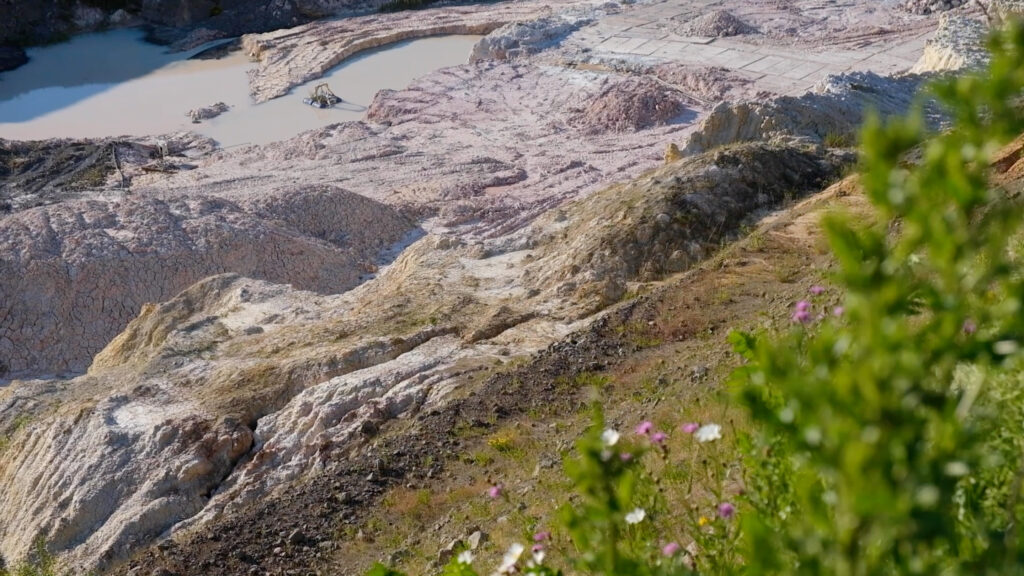
The surrounding area has around fifty active clay mines as well as uncountable inactive, recultivated or abandoned mines. The distinguishing features of Westerwald stoneware are its high density, hardness and durability. The clay pits contain a wide variety of colors and qualities of clay. Around twenty different clays can be found in a single pit. The best qualities of clay are found in the deepest layers of the mines. On average, the clay extraction pits are around thirty meters deep. The deepest pit is located near Meudt and is up to ninety meters deep. Clay mining changes the landscape drastically. In Germany, it takes many years to obtain permission to open a clay pit, as everything has to be approved by the authorities, including recultivation after the pit is closed. Two-thirds of the mined clay goes to the production of industrial wares.
In spring 2023 Tontouristen travelled around the area. We could not believe our eyes the first time we saw a clay mine (named Esther). It was so much larger than we had ever imagined. The various colors of the clay were beautiful and appeared almost surreal against the backdrop of industrial activity. A few days later, we had the opportunity to visit the largest pit and drive down to its bottom. A constant flow of blue trucks were driving up and down the roads on the side of the mine. There was an enormous gap in perspectives between the small ten-kilo bag we used to open in our studios while standing at the bottom of a massive clay pit. In the clay factory, we learned about the energy-consuming process of making clay and producing grog. The clay needs to undergo several stages: sorting, drying, crushing, mixing, extruding and packing before being shipped all over the world. As energy prices rise and regulations around opening new mines tighten, clay is likely to become more expensive, and with the high-quality deposits in Westerwald potentially depleted within 300-500 years, the future of ceramics raises critical questions – will clay become a scarce, high-priced commodity?
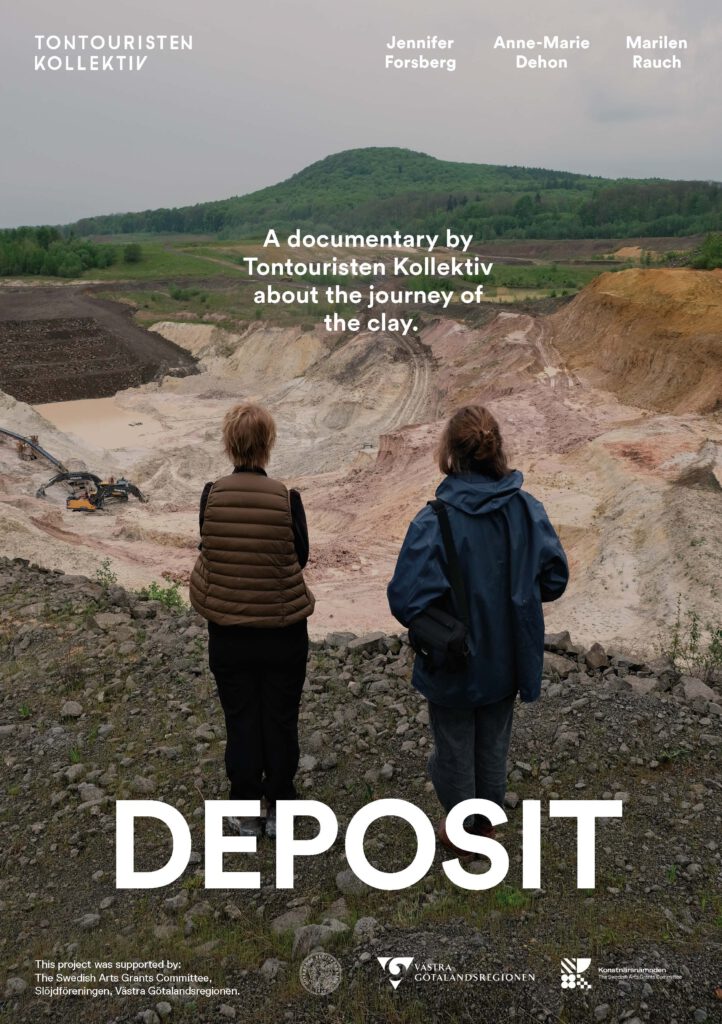
We emphasized the practice of gathering information with all our senses, using sound recordings, photos, videos, words, movements in nature, and writing as our tools. The resulting work “Deposit” is a three-channel video, where different aspects of mining are reflected upon: the nature, the factory, and the mine. We explored the interconnections between these elements within the clay extraction process. What caught our attention the most was the interference with natural habitats and the lasting scars in the landscape – changes that cannot be overlooked and reversed.
In the spring of 2024, we returned to Westerwald and were invited as guest lecturers by the IKKG to work with a group of students for some weeks. We asked the performance artist and researcher Dr. Nathalie S. Fari to lead a week of experimenting workshops where we learned ‘Body Mapping’ – bodily interventions as methods to find new layers and stories. Together, we explored the old Kannofen, a historic and one-of-a-kind kiln for salt firing at the university’s property and, later, the pottery market in town. The method of ‘Body Mapping’ was helpful for seeing ceramics with new eyes.
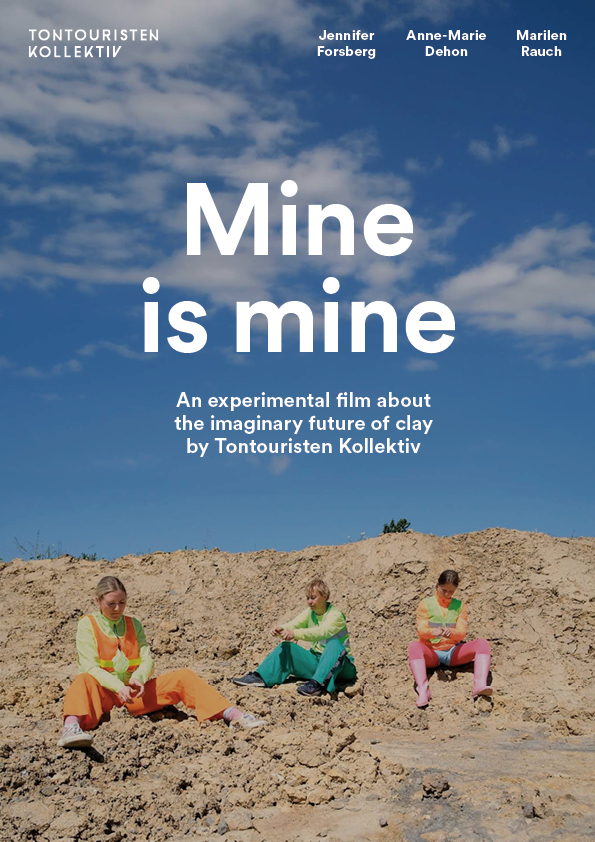
During these weeks, we made our second work, “Mine is mine”. The film was produced as a series of connected sequences performed and filmed around the clay mines. Access to the clay mines is strictly prohibited, both for active sites and those that are temporarily or permanently inactive. The numerous signs telling us to keep out were triggering, almost inspiring. We filmed on the rim of a big mine. Like the grass and shrubs, we could overlook the mine but not enter it. The atmosphere felt very special; we asked ourselves, ‘Are we intruders, or are we nature?’ We tried to identify with nature who is just waiting to take back the ground, slowly and invisibly trespassing. The work depicts a playful limbo, a trancelike stage disconnected from time.
By using our own bodies, we investigated a feeling of being something between humans and nature, approaching with curiosity and creativity. We performed a series of interventions to explore the imaginative future of clay as a resource and cultural heritage. In one scene, we threw pots in the air, imagining a world where clay is depleted – would the gestures of making persist even without the material? In another scene, we buried a salt-glazed pot, reflecting on a time when traditional Westerwald stoneware production is no longer a practiced craft, turning into an archaeological relic. We also enacted waiting at the clay mines, confronting the uncertainty of access to the resource. In another scene, we reclaim the power of the clay pits and the territory owned by private companies.
Next to a clay pit, we encountered a mining machine. In contrast to its rigid, mechanical function, we responded with soft, flowing movements – an act of resistance against the harsh logic of extraction. This contrast embodied the tension between industry and craft, mechanization and human touch. These performative interventions allowed us to engage with clay beyond its physical properties, tracing its deeper ecological, cultural and historical weight. While performing close to the mines, we felt a profound connection to the ground – more than we used to when just working with clay, but moving through it, entangled in its past, present, and speculative future.
Digging deeper into the material narratives is an eye-opening journey. We ask ourselves new questions. Are powerful narratives created by ourselves as comfort and justification? Do we direct them to fit our needs? Who are we as individual small-scale artists in this? Who has the right to take this material stored deep down in the ground? Clay may become a much more expensive material. What will that do to the crafts? Clay has been seen as a cheap, almost free material, what happens when it becomes more pricey? Who will work with it? Who will pay for the outcomes?
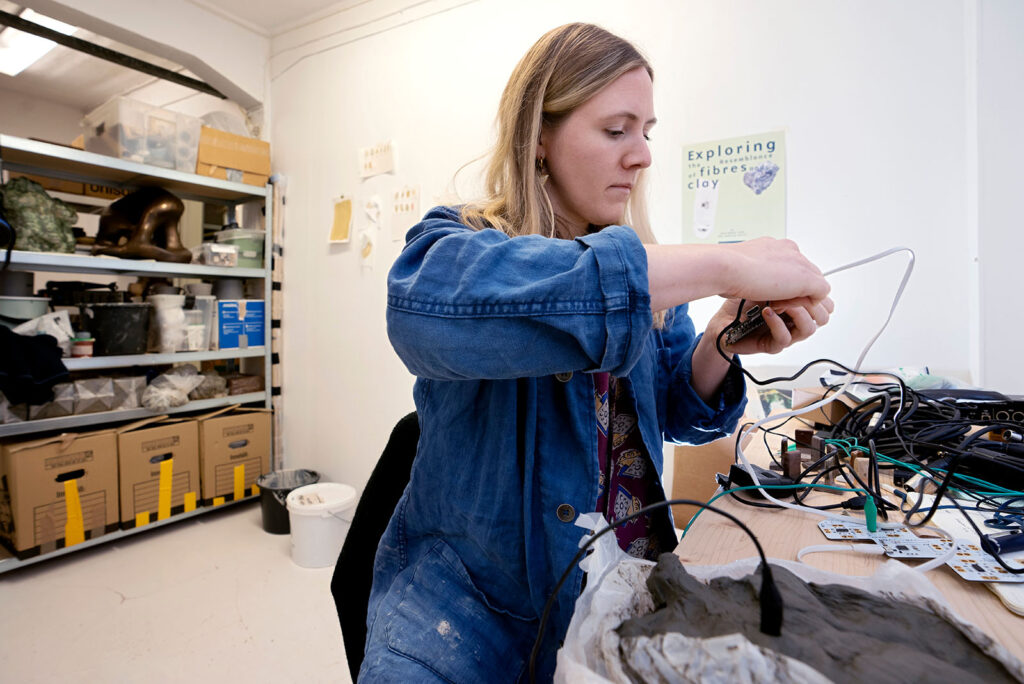
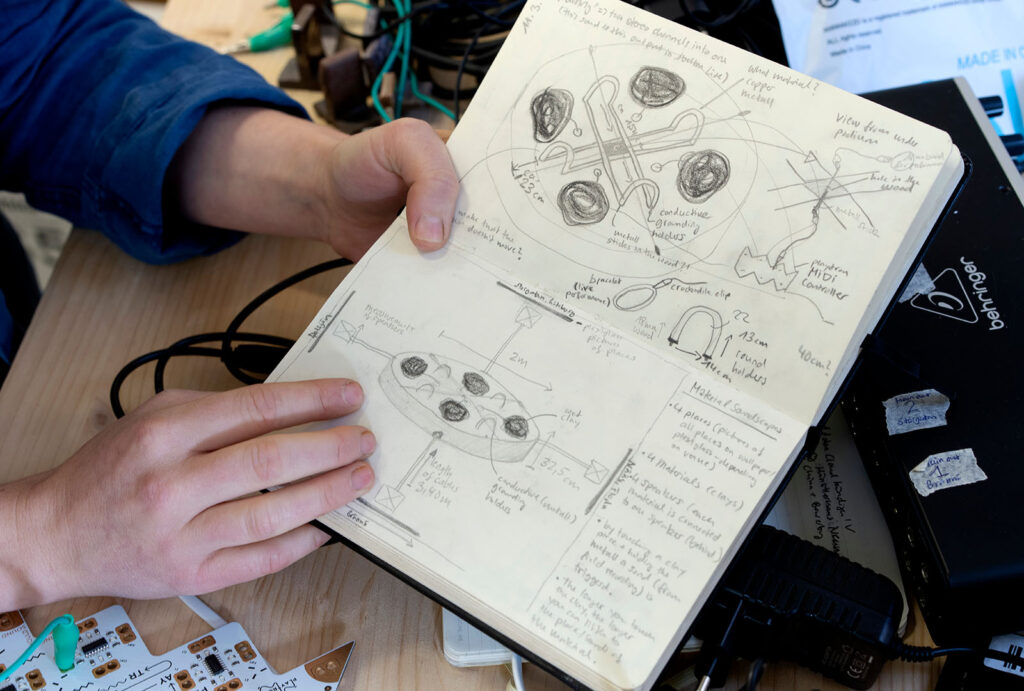
In October journalist Camilla Adolfsson and photographer Johan Wingborg visted my studio to write an alumni protrait for the website of University of Gothenburg.
Marilen Rauch has had her workshop at the old Klippan sugar mill, right next to the Röda Sten Konsthall and the Göta Älv river, for more than a year now. She shares the premises with six other Gothenburg-based ceramicists, most of whom – like Marilen – have master’s degrees from HDK-Valand. Marilen doesn’t spend all that much time at her workshop. She’s hardly been here since she graduated. Instead, she’s been away on various artist residencies and scholarship trips to countries such as South Korea, Estonia and Denmark. But now she’s planning to stay in Gothenburg, at least for a while. A performance at the artist-run cultural scene 3:e Våningen will be happening soon.
“Yes, I’m going to be part of a concert programme named Oljud, Noise. Not that I’d call myself a sound artist. But I do enjoy combining ceramics with other things I like. Like sound,” says Marilen.
This is how she works these days. She used to create free-form sculptures and enjoyed “just doing things”, without really having to think too much. But her entire artistic practice altered fundamentally at HDK-Valand. She now describes her works as conceptual. The turning point came when she relocated to Gothenburg and realised that more or less the whole city rests on clay.
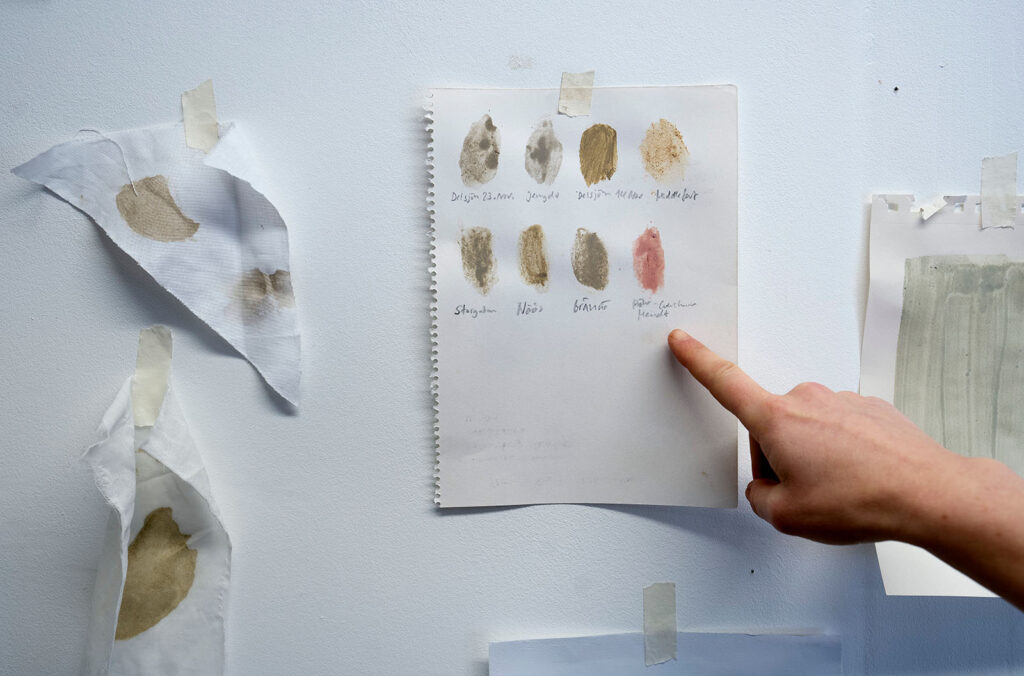
“There’s so much of it! I started digging at Delsjön lake initially, and collected clay there. Then I found some on construction sites near the school. At Nääs and on the island of Brännö,” says Marilen.
“Of course, I was able to collect materials from the storeroom at the school,” she continues, “but it seemed strange to do that when I could find clay all over the place. I want a link to the materials I use.” Actually collecting the clay took some time. As did cleaning it. Around the same time, Marilen began recording sounds from the places where she’d collected her clay. Ultimately, this process culminated in her thesis entitled “Material Soundscapes”. This is an interactive installation where onlookers can touch the clay, relate to its original location and even listen to it.
Marilen says she’s driven by a desire to experiment. That she’ll go on mixing, blending and exploring other materials and art forms – but without abandoning clay. She explains how she developed an interest in ceramics when she was ten. Back then, she was a student at a school in Esslingen, Germany, not far from Stuttgart, and creativity was part of day-to-day life. “I’ve been working with it ever since. It was love at first sight,” says Marilen.
Even so, she decided initially to pursue a different path in terms of her education. Not only was there no art school offering ceramics anywhere near her, but she also enjoyed graphic design. She ended up with a bachelor’s degree in graphic design from the University of Applied Sciences in Mainz. But she also spent an exchange year in Gdańsk, Poland, just so that she could pursue ceramics as well. And then she moved to Sweden – for the first time.
“I studied at Nyckelviksskolan in Stockholm, and heard about HDK-Valand and Konstfack, the University of Arts, Crafts and Design. I applied to both, but I wasn’t successful,” says Marilen. She headed back to Germany. But before long, she decided to give Gothenburg another go. “I arrived here just as the pandemic was starting. That was an unusual time, but we got to spend time at the incredible ceramics studio at the academy. So things were better here than in Germany, where everything was locked down,” she says.
Marilen doesn’t know whether the pandemic was to blame, but she’d have liked to see more contact across programme boundaries during her studies at HDK-Valand. “Study programmes in Germany are more interdisciplinary and you have more opportunities to choose different courses. That said, our little ceramics team was great, we enjoyed what we were doing, and we were able to collaborate with the textile art and jewellery art programmes to an extent.”